DFM Case Study: Preventing Shrinkage Porosity with 4 Auxiliary Ribs Before Tooling
A telecom equipment manufacturer was preparing to tool a new communication cavity housing. Moldflow predicted a severe shrinkage hot spot in a thick section — a risk that would normally be discovered after T1 trial, requiring squeeze pin insertion and mold rework. VOXEL's RF engineers reviewed the design and identified where four auxiliary ribs could be added without affecting RF performance, then machined off after casting. The risk and solution were submitted to the customer for confirmation before any mold steel was cut — eliminating the defect at zero tooling rework cost.
Before
Moldflow predicted shrinkage porosity in a communication cavity thick section — squeeze pin would mean mold rework after T1 trial.
After
Four RF-aware auxiliary ribs added in CAD, customer-confirmed before tooling — T1 clean, zero rework.
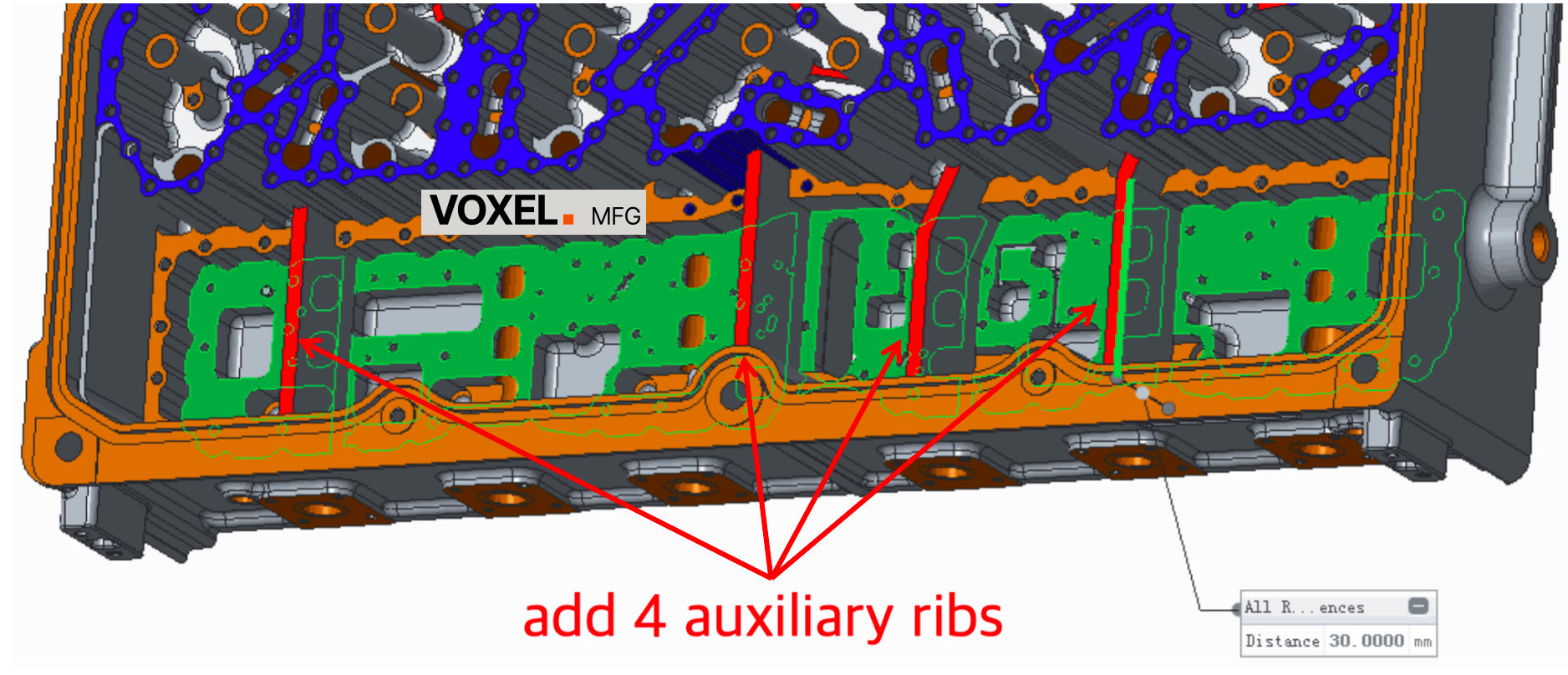
Strategic placement of 4 auxiliary ribs to balance thermal mass and eliminate shrinkage porosity
The Problem: A Shrinkage Risk Caught Before Tooling — Not After
A telecom equipment manufacturer was preparing to release tooling for a new communication cavity housing — a die-cast part that would house RF filter components. The design had a thick section that Moldflow flagged as a shrinkage risk: the area would remain liquid significantly longer than surrounding material, creating a last-to-freeze zone with poor feeding and high porosity probability.
Their mold supplier proposed a squeeze pin — the industry-standard response to shrinkage in thick die-cast sections. It's a reasonable fix, but it means mold modification after T1 trial, three weeks of added lead time, and extra tooling cost. More importantly, it means discovering a predictable problem after steel is cut, when changes are expensive and delays cascade to production commitments.
The customer asked VOXEL to review the design before committing to tooling. They wanted to know: could this risk be eliminated at the design stage, before any mold steel was cut? This is exactly what DFM is for — solving problems when change is cheapest and options are widest.
Why It Was Hard: Adding Ribs Without Creating New RF Risks
The mold supplier's squeeze pin proposal was completely reasonable — it's the standard industry response. But it treats the symptom after tooling is built, when changes are expensive and delays cascade. The real question was: could a design-stage solution eliminate the risk entirely?
The answer was auxiliary ribs — but this is a communication cavity, not a generic enclosure. Adding ribs to an RF cavity isn't simply drawing lines in CAD. Ribs change the internal geometry, which can affect cavity resonance, field distribution, and ultimately RF performance. The ribs had to be placed where they would accelerate cooling in the thick section without degrading the cavity's RF characteristics — and they had to be machined off after casting without leaving surfaces that could affect PIM or EMC.
This is where having RF engineers on the team made the difference. A general DFM reviewer might propose ribs based on thermal analysis alone, but cannot assess whether those ribs will interfere with RF performance. VOXEL's RF engineers could evaluate both: the thermal benefit of the ribs and their RF impact. They confirmed that four precisely positioned ribs would rebalance the thermal distribution without affecting cavity performance — and that machining them off after casting would not create new risks at the RF interfaces.
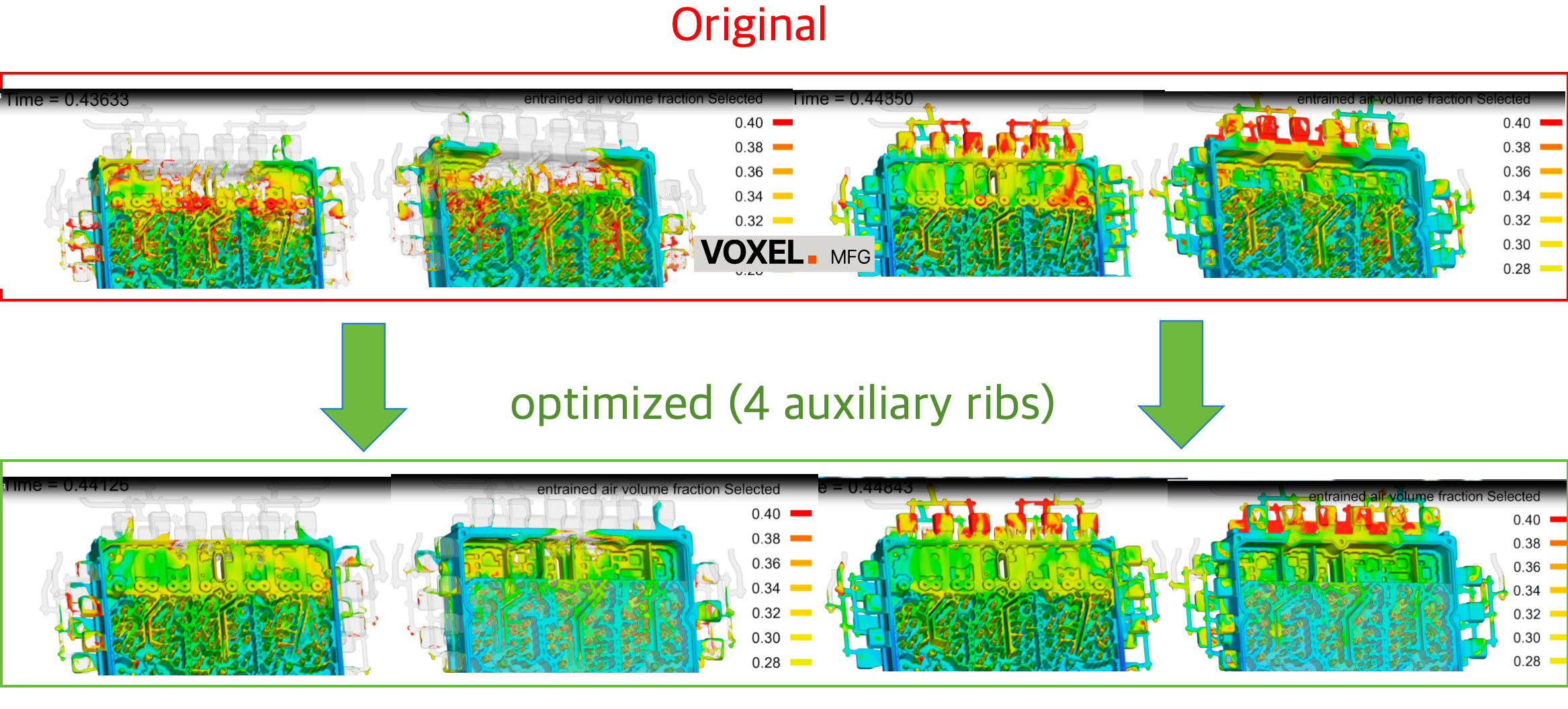
Moldflow thermal analysis: Before and after comparison showing hot spot elimination with auxiliary ribs
Engineering Actions: RF-Aware Ribs, Customer-Confirmed Before Tooling
Using Moldflow, we verified the shrinkage hot spot and determined that four auxiliary ribs could rebalance the thermal distribution. But the ribs required more than thermal calculation — they required RF-aware placement. Our RF engineers evaluated each rib position for both thermal benefit and RF impact, confirming that the proposed locations would not affect cavity resonance or field distribution.
We also confirmed that machining the ribs off after casting would not create new risks: the machined surfaces would not be at RF-critical interfaces, and the removal process would not affect PIM or EMC performance. This is a judgment that requires RF engineering experience — a general DFM reviewer cannot make this call.
The complete risk assessment and proposed solution — including rib positions, thermal simulation results, and RF impact evaluation — were submitted to the customer for review. Only after the customer confirmed the approach did we proceed with the updated CAD for tooling release.
- Thermal balancing: Precisely positioned ribs increased local surface area and accelerated cooling in the thick section, eliminating the isolated hot spot.
- RF-aware placement: Each rib position was evaluated for RF impact — confirmed no effect on cavity resonance, field distribution, or PIM performance.
- Safe machining removal: Ribs are machined off after casting; confirmed that removal surfaces are not at RF-critical interfaces and will not affect EMC.
- Customer confirmation before tooling: Risk assessment + solution submitted to customer; tooling released only after customer approval.
Verification and Results: Risk Removed Before Steel Was Cut
After the CAD update, we re-ran the Moldflow study. The hot spot disappeared, the thermal map balanced out, and the shrinkage risk was removed before the tool entered manufacturing.
The customer reviewed the complete DFM report — including the Moldflow results, rib placement rationale, RF impact assessment, and machining removal plan — and confirmed the approach. Tooling was released with the updated CAD. The T1 trial produced sound castings with no shrinkage porosity in the previously flagged zone. No squeeze pin needed, no mold rework, no trial delays.
Engineering Takeaway
The value of a DFM review for communication cavities isn't just catching thermal risks — it's having RF engineers who can propose solutions that work for both casting and RF performance. A general DFM reviewer might flag the shrinkage risk, but cannot assess whether adding ribs will affect cavity resonance or PIM. VOXEL's RF engineers evaluated both, and the customer confirmed the approach before tooling was released. The problem was solved in CAD — zero tooling modifications, zero trial delays.
What the Client Said
"Our mold supplier flagged the shrinkage risk and proposed a squeeze pin — a standard fix, but one that adds time and cost after tooling. We wanted to know if the risk could be eliminated before committing to steel. VOXEL's DFM review went beyond thermal analysis — their RF engineers confirmed where ribs could be added without affecting cavity performance, and that machining them off wouldn't create new RF risks. We reviewed and approved the proposal before tooling release. T1 came back clean — no squeeze pin needed."
— RF Engineer, Telecom Equipment Manufacturer
Business Outcome
Zero
Shrinkage porosity risk after DFM correction — RF-aware ribs eliminated root cause before tooling
3-4 weeks
Schedule saved by solving in CAD before tooling — no mold rework, no trial loops
$8K-15K
Post-T1 mold rework costs avoided — squeeze pin insertion and trial loops eliminated
RF-aware DFM
Ribs evaluated for both thermal and RF impact — customer confirmed before tooling release
Explore more engineering case studies on our Case Studies page.
Frequently Asked Questions
Why is DFM the best stage to eliminate shrinkage porosity risk?
DFM is the best stage because geometry changes are still inexpensive before tooling is released. Once the mold is built, the same thermal problem usually requires inserts, rework, or extra trials that cost far more than an early CAD correction.
How do auxiliary ribs reduce shrinkage porosity risk in thick sections?
Auxiliary ribs help thick sections cool more evenly by increasing local surface area and reducing the isolated hot spot that drives shrinkage. They can also improve how the area feeds during final solidification, lowering the chance of void formation.
Why wasn't a tooling fix or squeeze pin the preferred solution here?
Because VOXEL identified the risk before tooling release, the cleanest fix was still a low-cost geometry update. Waiting for tooling correction would have added avoidable cost and time to solve a problem that was already visible in simulation.
How does Moldflow help predict shrinkage porosity before tooling?
Moldflow shows where the part remains liquid longer than surrounding areas and where feeding support becomes weak during solidification. Those hot spots highlight the sections most likely to form shrinkage porosity, giving engineers a chance to change the design before steel is cut.