RF Cavity Filter Case Study: Eliminating Porosity and Achieving Low-PIM Surface Finish
A telecom equipment manufacturer was qualifying a new 5G base station filter cavity. PIM (Passive Intermodulation) testing kept failing — when PIM doesn't pass, the whole unit fails final test, driving batch yield below acceptable thresholds and forcing the assembly line to stop. The root cause was shrinkage porosity at the connector holes on the cavity body — these are die-cast features that cannot be machined, so porosity there directly degrades PIM with no post-process fix. VOXEL eliminated the porosity through high-pressure spot cooling in the mold, then refined CNC toolpaths to deliver a Ra 0.116 mating-surface finish — stabilizing low-PIM performance and restoring assembly-line yield.
Before
Hidden shrinkage porosity and unstable mating-face finish created a double qualification risk: low-PIM instability plus potential RF shielding issues.
After
Spot-cooling plus CNC interface optimization delivered dense casting structure and Ra 0.116 contact quality without forcing a full housing redesign.
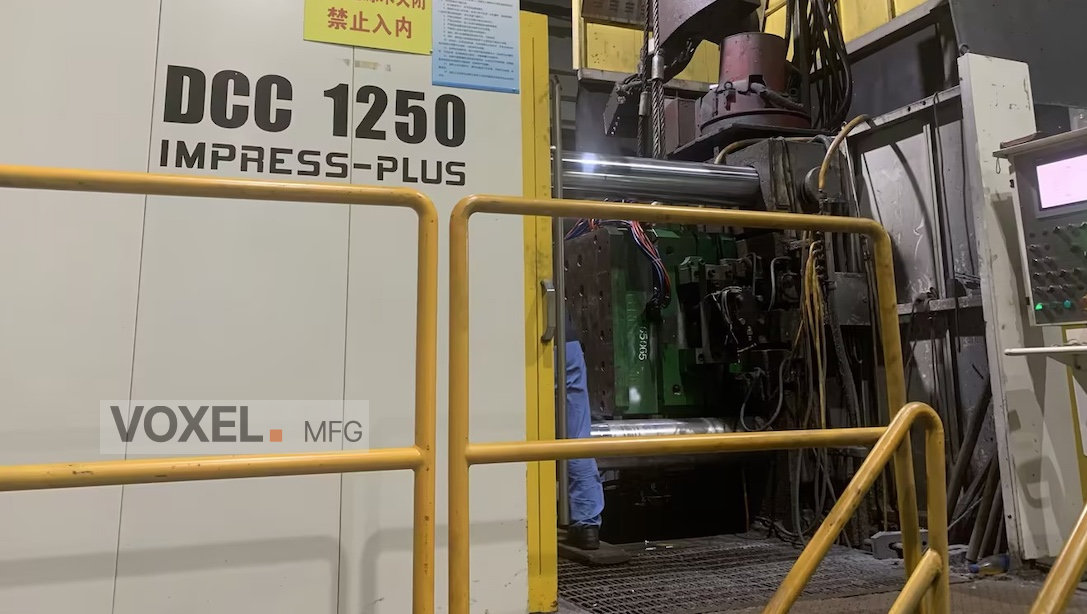
DCC 1250-ton die-casting machine used for manufacturing large-scale, precision telecom and RF cavity enclosures at Voxel Manufacturing
The customer was a telecom equipment manufacturer producing 5G base station filter cavities. PIM (Passive Intermodulation) was exceeding spec — and in this context, PIM failure doesn't mean a single rework. It means the whole unit fails final test. When too many units fail, batch yield drops below the threshold needed to sustain production, and the assembly line stops. For a manufacturer shipping to operator deployment schedules, a stopped line means missed deliveries and contractual penalties.
Their RF engineer had correctly diagnosed the problem: shrinkage porosity at the connector holes on the cavity body. These holes are die-cast features — they are not machined after casting, so if porosity forms there during solidification, there is no post-process fix. The porosity degrades the metal-to-metal contact at the RF interface, directly causing PIM failure. Additionally, the mating face between the cavity and cover plate required a telecom-grade surface finish to prevent PIM-degrading non-linearities at that interface. Two separate problems, both contributing to the same PIM failure — and both had to be solved together to restore yield.
The Problem: Two Separate Issues, One PIM Failure
The customer's RF engineer had already localized the root causes. There were two separate problems, each contributing to the same PIM failure:
Porosity at the connector holes: The connector holes on the cavity body are die-cast features — they are not machined after casting. When shrinkage porosity forms there during solidification, it degrades the metal-to-metal contact at the RF interface, directly causing PIM failure. Since these holes cannot be reworked by machining, the only fix is to eliminate the porosity at the casting stage.
Surface finish on the mating face: The contact surface between the cavity and cover plate needed telecom-grade finish to prevent PIM-degrading non-linearities at that interface. This is a CNC machining challenge — but it only matters if the casting underneath is sound.
The responsibility between the foundry and the CNC shop was clear — connector-hole porosity belongs to casting, mating-face finish belongs to machining. But the customer needed both problems solved together, because PIM depends on both: a dense casting with a rough surface still fails PIM, and a smooth surface on a casting with connector-hole porosity still fails PIM. The customer needed a team that could address both issues in a coordinated way and verify the combined PIM result.
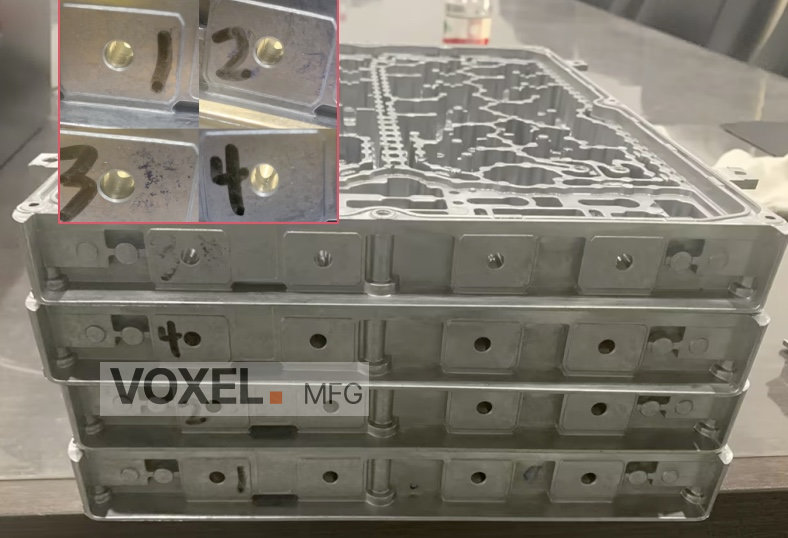
Die-cast RF filter housing after mold optimization, showing uniform internal structure with shrinkage porosity eliminated
Why It Was Hard: Two Problems, One PIM Result — Both Must Pass
The customer's diagnosis was correct — but solving each problem alone doesn't restore yield. Eliminating connector-hole porosity doesn't help if the mating face is still too rough for low-PIM contact. Optimizing the mating-face finish doesn't help if connector-hole porosity is still degrading the RF path. PIM depends on both interfaces being right simultaneously — and neither the foundry nor the CNC shop could verify the combined PIM result on their own. The customer needed a team that could solve both problems and confirm the final PIM pass.
Engineering Actions: Solve Both Problems, Verify the Combined Result
The customer had done the hard part — identifying both root causes. What remained was solving each one and verifying the combined PIM result. The customer provided PIM data and analysis. VOXEL built a two-stage plan — first eliminate the connector-hole porosity at the casting stage, then optimize the mating-face finish at the machining stage — with customer PIM verification after each stage.
1. Resolve casting density with the foundry team
The connector holes are die-cast features that cannot be reworked by machining — the porosity had to be eliminated at the source. Working with the casting team, we integrated four spot cooling channels into the mold slider, adjusting positions twice based on simulation before the final configuration eliminated shrinkage porosity at the connector holes. The customer verified PIM improvement after this stage.
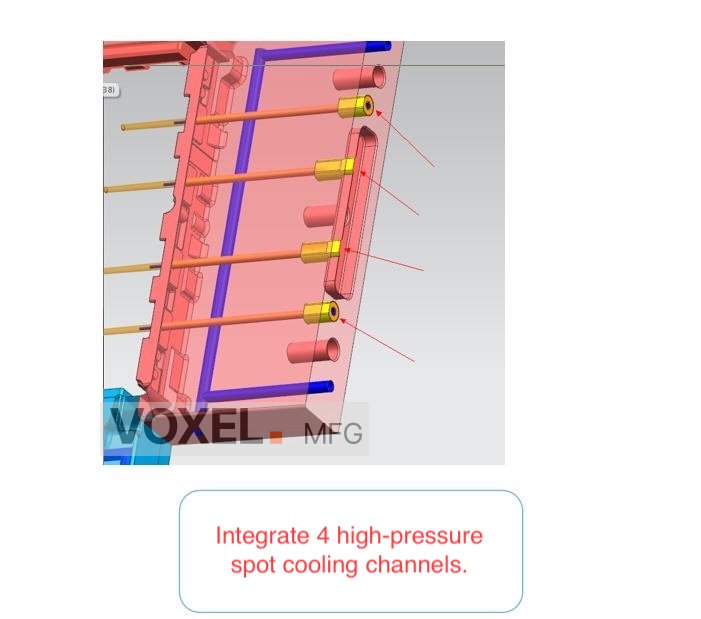
3D mold design showing 4 high-pressure spot cooling channels to eliminate shrinkage porosity in RF cavity filters
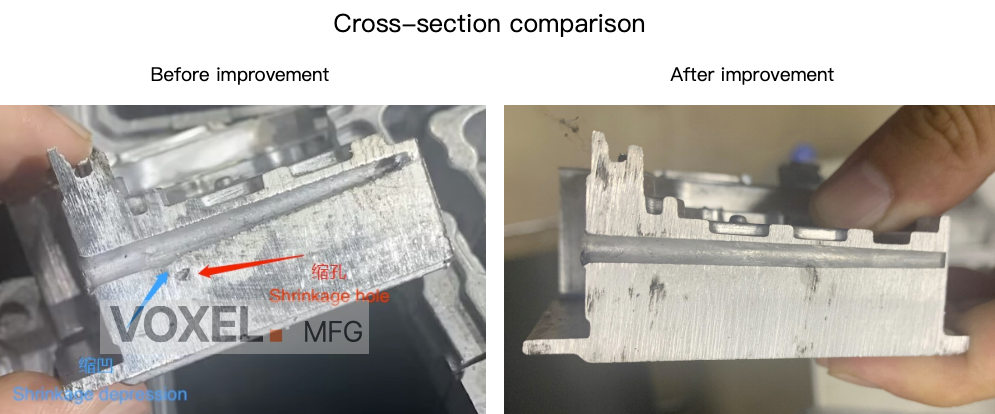
Cross-section comparison showing the complete elimination of die-casting shrinkage porosity in telecom hardware
2. Optimize the mating-face finish with the machining team
With connector-hole porosity resolved, the mating face between the cavity and cover plate still needed telecom-grade surface finish for low-PIM contact. We refined CNC parameters through three test rounds — adjusting tools, feeds, and cutting depth. Using anti-vibration tooling and optimized feeds, we reached Ra ~0.12 (tested areas Ra 0.116). The customer performed final PIM verification after this stage.
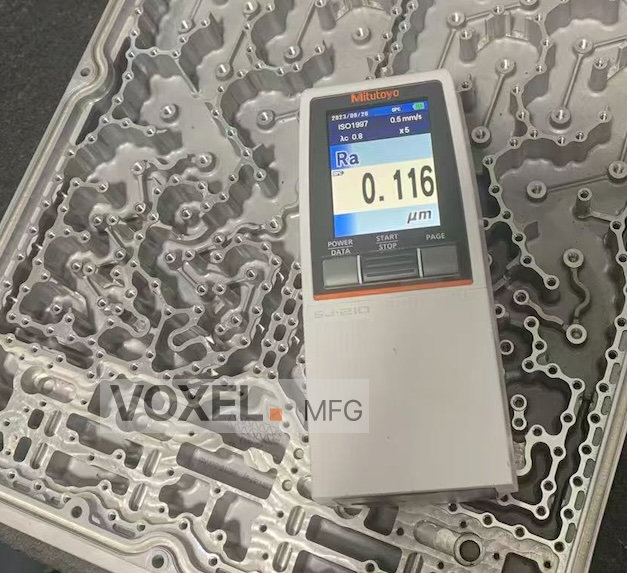
Surface roughness tester showing Ra 0.116 on a CNC machined RF cavity filter for ultra-low PIM performance
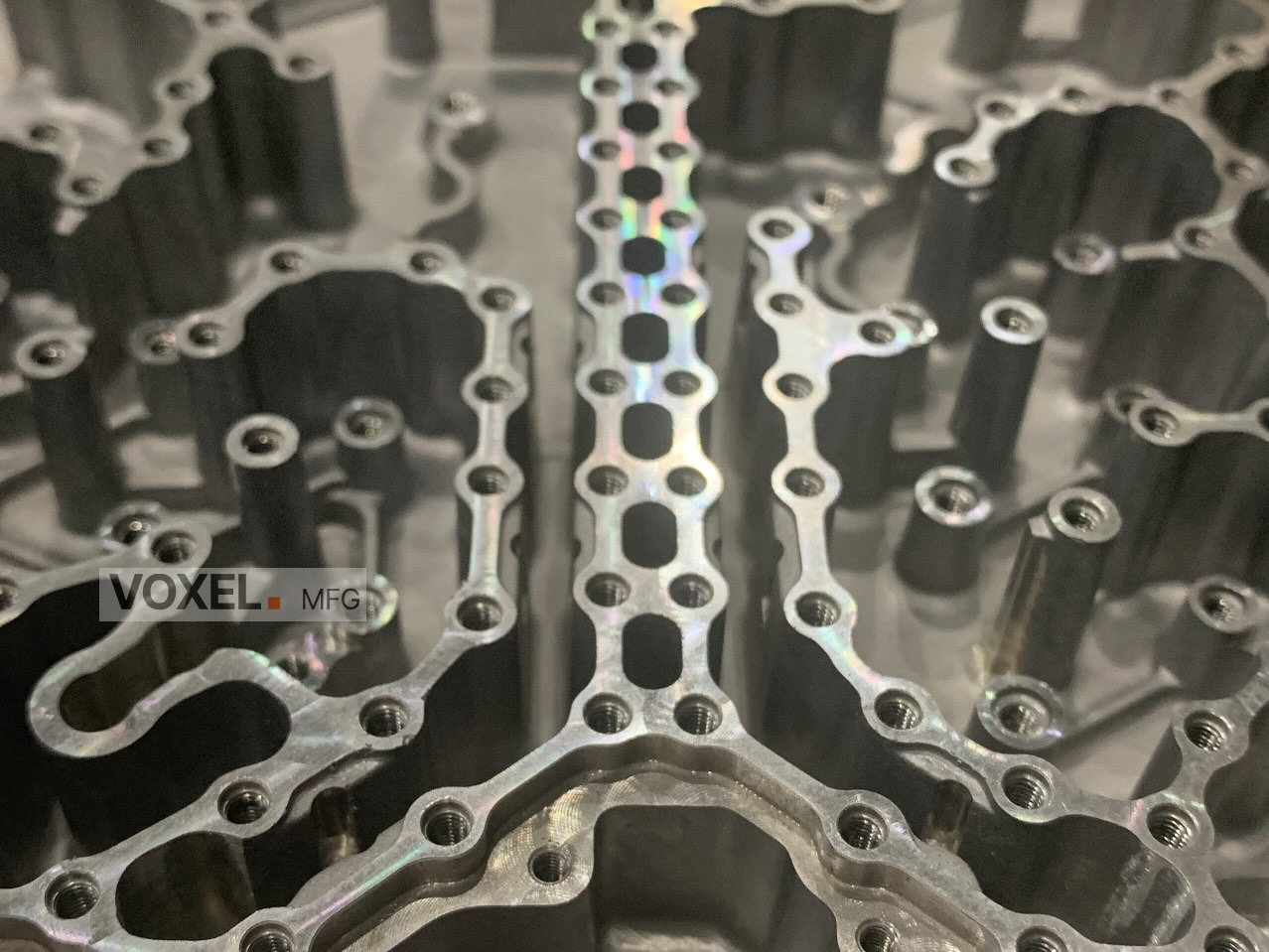
Mirror-like CNC machined surface finish on RF cavity cover plate to ensure low Passive Intermodulation (PIM)
Verification and Results: Confirmed by the Customer at Each Stage
The customer verified PIM after each stage — eliminating connector-hole porosity reduced PIM contribution, then mating-face optimization brought PIM within spec. Neither alone sufficed.
- Porosity eliminated through spot-cooling (positions adjusted twice)
- Cross-sections confirmed dense cavity structure
- CNC refined through 3 rounds to Ra 0.116 (tested)
- Customer-verified PIM pass on first full run
Engineering Takeaway
PIM failure in RF cavity filters often comes from two separate problems that must both be solved: connector-hole porosity (a casting issue with no machining fix) and mating-face finish (a CNC issue). Neither the foundry nor the machining shop could verify the combined PIM result on their own. The customer's diagnosis was correct — they knew both factors. What they needed was a team that could solve both problems and confirm the final PIM pass, restoring assembly-line yield.
What the Client Said
"We identified the PIM issue early and knew both connector-hole porosity and mating-face finish were contributing. The porosity at the connector holes was particularly frustrating — those are die-cast features that can't be reworked by machining, so the only option was to fix it at the source. VOXEL eliminated the porosity through spot cooling in the mold, then optimized the mating-face finish — and delivered a part that passed PIM testing on the first verification run. Assembly-line yield recovered immediately."
— RF Engineer, Telecom Equipment Manufacturer
Business Outcome
Ra 0.116
Surface finish achieved — PIM passed on first verification run, assembly-line yield restored
3-4 weeks
Schedule saved by solving casting and machining in one coordinated cycle
$10K-18K
Scrap and rework costs avoided — plus avoided assembly-line stoppage and delivery penalties
Yield restored
Connector-hole porosity eliminated at source + mating-face finish optimized — both PIM paths addressed
Explore more engineering case studies on our Case Studies page.
Frequently Asked Questions
Why is shrinkage porosity a serious risk in RF cavity filter housings?
Shrinkage porosity reduces local density in the cavity body, which weakens the structure and can compromise RF shielding integrity. In this project, the issue came from a thermal hot spot during solidification, so the solution had to come from mold thermal control rather than post-process repair.
How does surface roughness influence low-PIM performance?
Low-PIM performance depends on highly consistent metal-to-metal contact. If the contact surface is too rough, microscopic non-linear points form at the interface and can generate intermodulation. That is why the mating face had to be finished to Ra 0.116 rather than a standard machined value.
Why were high-pressure spot cooling channels used in this mold?
The spot-cooling channels were used because the porosity was being caused by a localized hot spot during solidification. Cooling that zone more aggressively rebalanced the thermal profile and removed the shrinkage source before the part ever reached CNC finishing.
What does this case show about combining die casting and CNC optimization?
It shows that RF hardware performance often depends on multiple processes being tuned together. Eliminating the internal porosity was necessary, but the part still required CNC toolpath and parameter optimization to create the telecom-grade mating surface needed for low-PIM behavior.
Got a challenging design? Let's solve it together.
Schedule a 15-minute feasibility call and receive a complimentary DFM & risk snapshot with feedback typically within 48 hours.