Telecom Mold Rescue Case Study: Eliminating Flash and Porosity After Tool Transfer
A mid-size telecom equipment manufacturer transferred their filter cavity mold to a new die-casting facility to optimize supply chain costs. After transfer, the mold produced 1.0mm+ flash and persistent porosity. The receiving factory recommended a full mold rebuild — a $30K-50K investment and 8-10 week delay. VOXEL was brought in to audit before that decision was made. We diagnosed three root causes — equipment mismatch, broken core pins, and lost thermal control — and restored stable production without a full mold rebuild, saving the original tooling investment and keeping the production schedule intact.
Before
Transferred mold runs showed severe flash and internal porosity, with unstable output and no reliable process window.
After
Tooling repairs plus machine-interface and thermal-control recovery rebuilt stable production without a full mold rebuild.
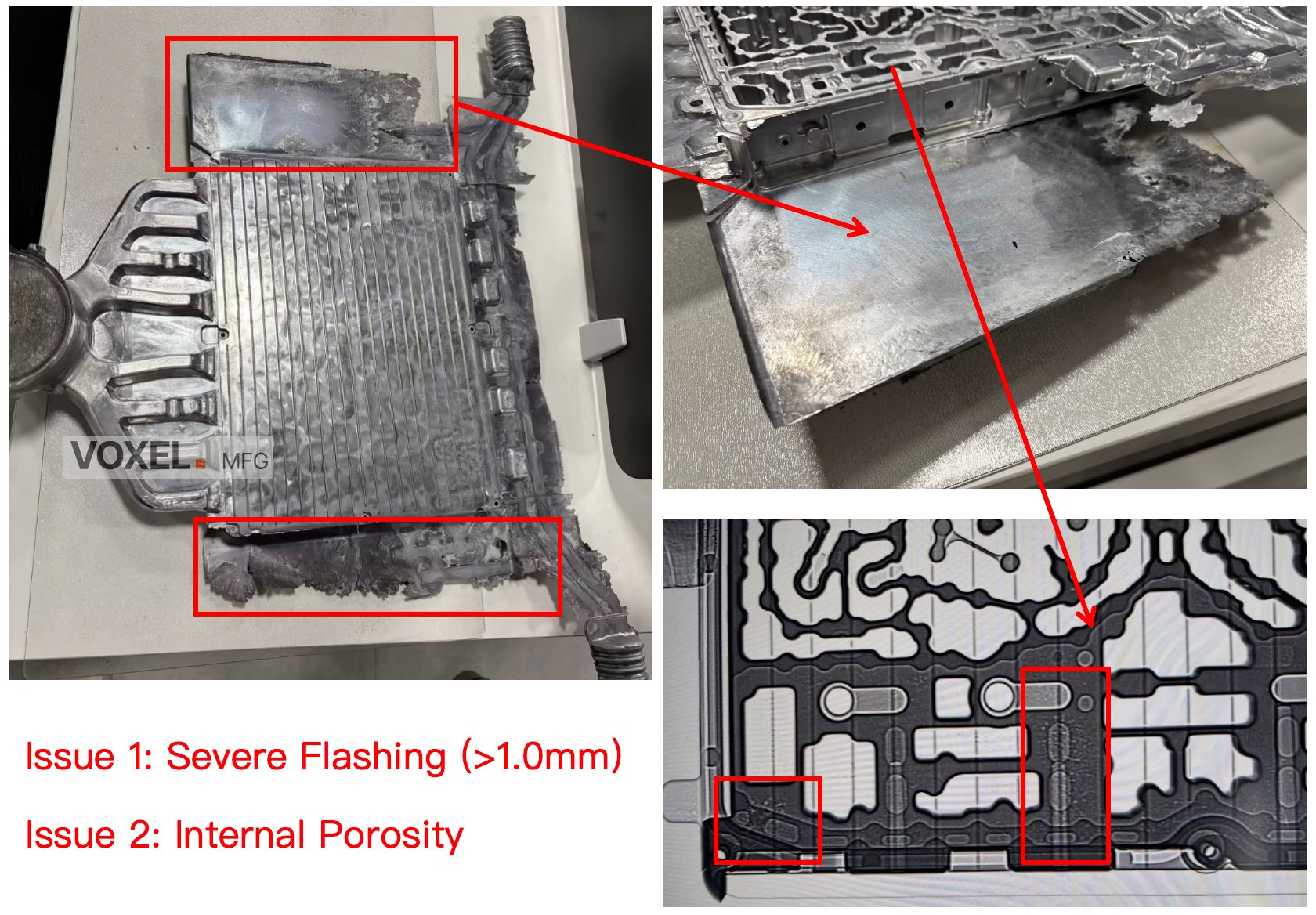
Telecom filter die casting severe flashing and X-ray showing internal porosity
The Problem: A Transferred Mold Failed as Soon as Production Restarted
A mid-size telecom equipment manufacturer had invested significantly in a communication filter cavity mold for their base station product line. To optimize supply chain costs and expand capacity, they transferred the mold to a new die-casting facility in Asia. The receiving factory conducted standard receiving inspections — visual checks, dimensional verification, water flow tests — all passed. Pilot runs began.
Then the problems started. Severe metal spray and over 1.0 mm of flash made the parts unusable for telecom hardware. The factory's mold engineer recommended repairs — first the sprue flange, then the core pins. Each repair helped temporarily, but new problems kept appearing. After three rounds of fixes, flash was reduced but internal porosity persisted, and dimensional drift started showing at the parting line.
The factory told the client: "We've done what we can with tooling repairs. The mold may need more extensive work, or the original design may not suit our equipment setup." The client faced a difficult decision. They had already invested in the transfer, paid for three rounds of repairs, and lost six weeks of production. A full mold rebuild would cost $30K-50K and add 8-10 weeks of delay — potentially missing their customer's delivery commitment. They needed an independent engineering assessment to determine whether the mold was truly unrecoverable, or whether the root causes had been missed.
Why It Was Hard: The Defects Were Coming From Multiple Failure Points
The factory was not incompetent — but their diagnosis was incomplete. From the receiving factory's perspective, "damaged mold" was a reasonable conclusion — flash and porosity together look like classic tooling wear. Mold transfer is a recognized high-risk operation, and even experienced factories can miss what standard inspections cannot catch. The deeper challenge was that three failure points masked each other: flash from equipment mismatch made porosity appear to be a tooling issue, while porosity distracted from the lost thermal management. Our joint audit with the factory's engineers revealed:
- Equipment mismatch: The sprue alignment flange diameter did not match the machine interface, so sealing at the shot side was unstable and metal spray escalated immediately.
- Tooling damage: Three core pins inside the mold were broken, creating local gaps and dimensional instability.
- Lost thermal control: Cooling water lines and hydraulic circuits were connected but not routed according to the original mold design — circuits that should have been separate were combined, and some zones received insufficient cooling. The tool was running with severe thermal imbalance that directly increased porosity risk.
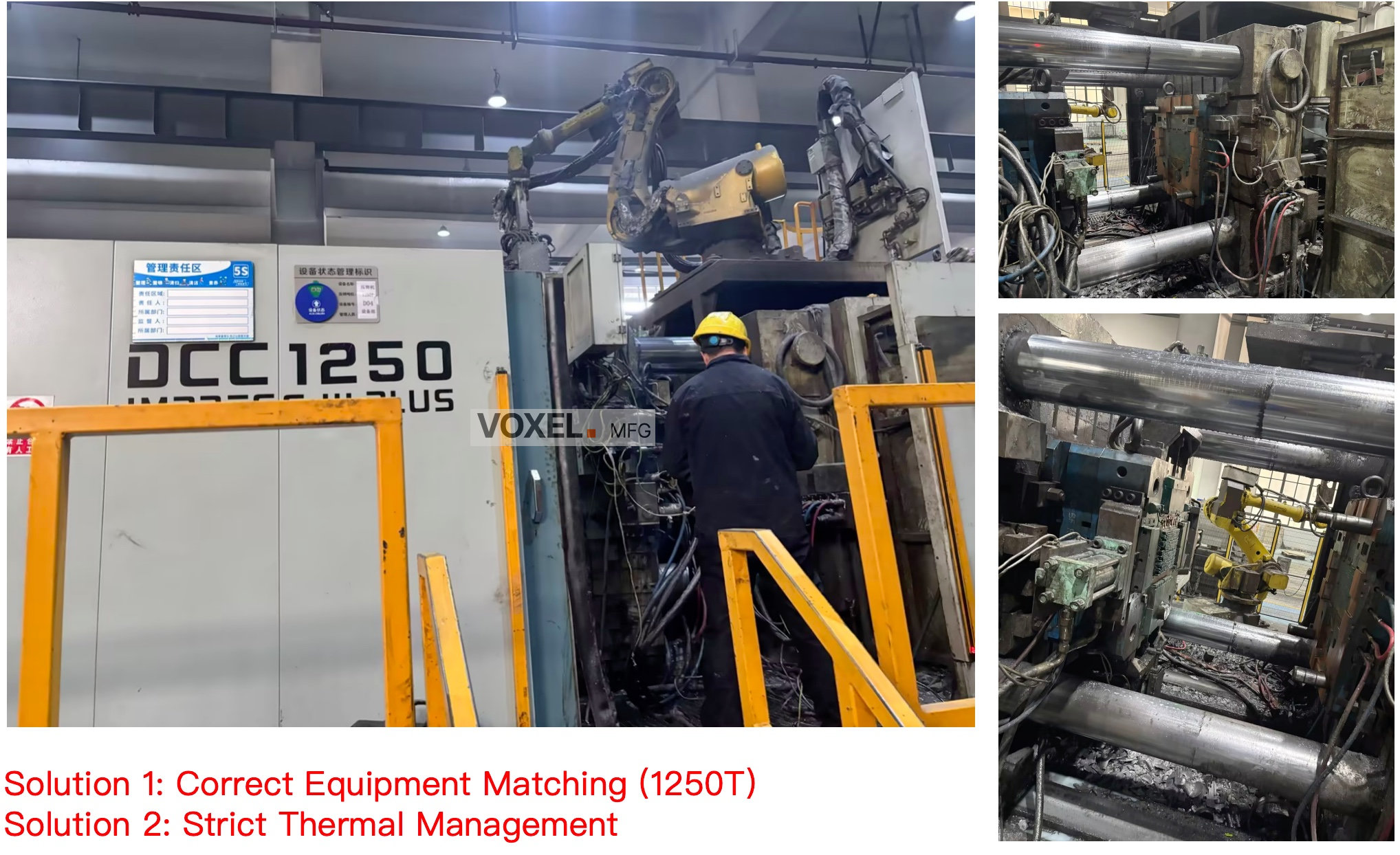
1250T die casting machine setup with strict thermal management and water lines connected
Engineering Actions: Recover the Tool, Then Rebuild Process Discipline
This was not about imposing solutions from outside — it was about uncovering what standard inspections could not see. VOXEL treated this as a mold-rescue project, working alongside the factory's engineers. The problems were uncovered layer by layer, and the customer actively participated in key decisions throughout the process.
- Equipment and tooling audit: Together with the factory team, we identified the sprue flange mismatch and broken core pins. The customer chose repair over replacement, protecting their original tooling investment.
- Machine matching: The recovered tool was mounted on a correctly matched 1250T die-casting machine. Flash reduced significantly — but porosity persisted, pointing to a deeper issue.
- Thermal control restoration: Further investigation revealed that cooling water and hydraulic circuits had been reconnected in a different routing than the original mold design — circuits that should have run separately were combined. Restoring the original thermal management plan resolved the remaining porosity.
Verification and Results: Flash Eliminated, Density Restored
After the repairs and process reset, the next pilot run passed the checks that had previously failed. We verified the recovery through both visible part condition and physical sectioning:
- Flash and metal spray eliminated: The severe overflow instability disappeared once the machine interface and tool shut-off conditions were corrected.
- Internal density restored: Physical cross-sections confirmed the cavity structure was dense and free of the obvious sand holes seen in the failed pilot condition.
- Dimensional stability recovered: The slider parting line showed no obvious mismatch, and the cavity height returned to the intended design condition without unusual secondary correction.
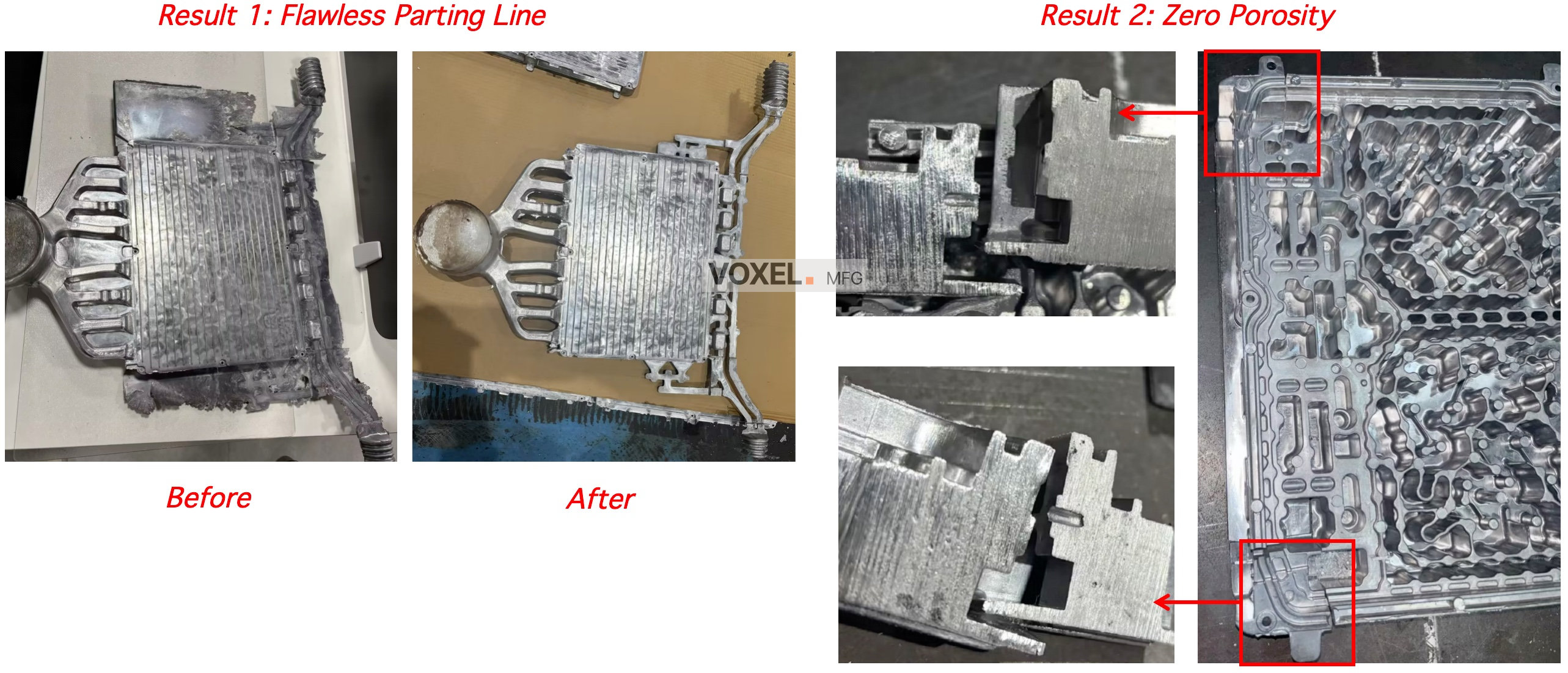
Physical cross section showing minimal porosity and clean parting line after repair
Engineering Takeaway
Mold transfer requires a systematic audit — not a single-point fix. In this case, machine compatibility, tooling integrity, and thermal control logic each needed separate verification before the tool could run reliably. If a pre-transfer audit had covered all three dimensions together, these issues could have been prevented. The lesson: inspect the system, not just the steel.
What the Client Said
"We knew mold transfer was risky and did our due diligence upfront — visual inspection, dimensional checks, water flow test, all passed. What we didn't expect was that the cooling circuits had been rerouted differently from the original design. Water was flowing, but the thermal management wasn't working as intended — that's not something a standard receiving inspection can catch. VOXEL's systematic audit saved us from a $50K new-mold decision that would have been unnecessary."
— Procurement Manager, Mid-size Telecom Equipment Company
Business Outcome
100%
Flash eliminated, density restored on 1250T — mold rescued instead of rebuilt
6-8 weeks
Faster recovery vs. new tool build — production restarted before customer delivery deadline
$30K-50K
New mold build costs avoided — plus saved the original tooling investment and transfer costs
Tool rescued
Original tooling investment protected — independent audit prevented unnecessary rebuild decision
Related Engineering Cases
If your project also involves sealing risk, porosity, or die-casting process recovery, the related IP67 leakage and RF cavity case studies show how we handle the same problem class from different engineering angles.
Explore more engineering case studies on our Case Studies page.
Frequently Asked Questions
What usually causes severe flash after a die-casting mold is transferred?
Severe flash after mold transfer is often caused by machine mismatch, poor sealing at the sprue side, or damaged tool features that create unintended gaps. In this case, the transferred mold had both a sprue flange mismatch and broken core pins, so the defect could not be fixed by clamping-force adjustments alone.
Why do broken core pins create both flash and dimensional risk?
Broken core pins create unintended gaps inside the mold, which allows molten metal to leak into areas that should remain shut off. That drives flash, shifts local dimensions, and increases the chance of further tooling damage if production continues without repair.
Why is thermal management critical in mold rescue projects?
When a transferred mold loses its original cooling and hydraulic setup, solidification becomes uneven and porosity rises quickly. Restoring the original thermal-control logic is often just as important as repairing the steel, because process instability can keep reproducing defects even after the visible tooling damage is fixed.
When is mold rescue a better option than building a new tool?
Mold rescue is the better option when the product design is still correct and the failure comes from transfer damage, machine mismatch, or missing process discipline. It restores production faster, protects the original tooling investment, and avoids the lead time of starting over with a new mold.
Got a challenging design? Let's solve it together.
Schedule a 15-minute feasibility call and receive a complimentary DFM & risk snapshot with feedback typically within 48 hours.